If you have already started looking for a luxury catamaran on the French Riviera, you have probably noticed the shortlist is short. That is not a fluke of your search. The Riviera’s charter fleet is built around motor yachts and megayachts, so locally based catamarans are genuinely scarce, and a real share of the catamarans that do work the Riviera each season are relocated in from elsewhere, most often Corsica, for a fee.
The good news: that is a solvable problem, not a dead end. This guide explains why the fleet between ports like Antibes, Cannes, Monaco, and St Tropez skews so heavily motor yacht, what relocating a catamaran from Corsica actually costs, and how we still get clients one when the public fleet page comes up short.
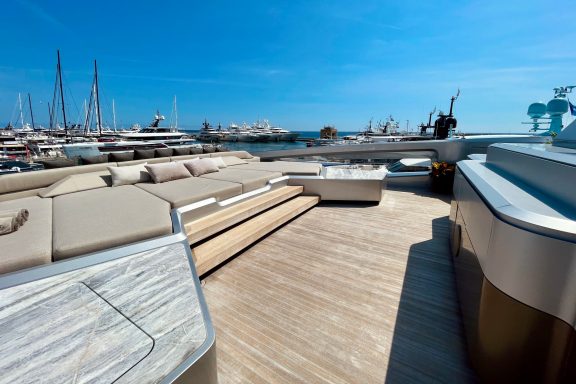
The Riviera’s marinas are full of motor yachts and megayachts. Catamarans are a small share of the local fleet.
Quick Take
- The Riviera’s fleet skews heavily motor yacht. A catamaran-only search will always turn up a shorter list here than in Croatia, Greece, or the BVI.
- Corsica is the main source for catamarans working the Riviera. Relocation fees we’ve seen run roughly €500 to €3,000, depending on distance and how much notice the yacht has.
- July and August squeeze an already-thin fleet the hardest. The earlier you ask, the more relocation options are still open.
- If your dates or group size make a catamaran genuinely hard to place, a motor yacht is usually the practical alternative on this coast.
Why Are Catamarans Hard to Find on the French Riviera?
The Riviera’s charter culture rewards speed and style between ports like Antibes, Cannes, Monaco, and St Tropez. Clients here are often moving between social stops in a single day, and owners who base their yachts on this coast tend to buy into that: fast motor yachts and megayachts that suit Port Vauban, the Cannes waterfront, and a Monaco stopover. Catamarans are built for a slower, more anchorage-focused style of cruising, which is a better match for Corsica, Sardinia, Croatia, or the Ionian than it is for a coastline built around marina-hopping and beach club lunches.
That does not mean catamarans are wrong for the Riviera. It means the locally based fleet is small, so if you search only what is physically berthed on the Cote d’Azur, you will come up short faster than you would searching the same budget in a catamaran-heavy region.
Where Do the Riviera’s Catamarans Come From?
We’ve had our own brokers hit this wall directly while sourcing for clients: a solid budget, workable dates, and still not enough Riviera-based catamaran options to shortlist. The answer, more than once, has been the same: look at catamarans currently based in Corsica that are willing to relocate to the Riviera for the charter.
This works because Corsica has a much deeper catamaran fleet than the Riviera does, and plenty of those yacht owners are open to a one-off relocation if the dates and fee work for their season. It is a normal, established booking path, not a workaround of last resort.

Corsica’s catamaran fleet is far deeper than the Riviera’s, which is why relocation has become a normal booking path rather than a last resort.
What a Relocation Fee Actually Costs
A relocation fee covers the cost of getting the yacht from its home base to your start point, usually fuel, crew time, and sometimes an extra day on either end of the charter. The amount depends on the distance and how much lead time the yacht has, so it is not a fixed number, but we’ve seen real examples at both ends: a sailing catamaran relocated from Corsica to Antibes for around €500, and a different yacht, on a longer route, with a relocation fee closer to €3,000. A reasonable working range for a Corsica-to-Riviera move is roughly €500 to €3,000.
Ask your broker for the relocation fee as its own line item before you compare total charter cost against a locally based yacht. It usually sits alongside the base rate the same way VAT, APA, and crew gratuity do (see our breakdown of what a French Riviera yacht charter actually costs for how those pieces add up).
“We get this exact question inside our own team, not only from clients. Three of our brokers have separately gone looking for a luxury catamaran on the Riviera and gotten the same answer: check Corsica. One of us booked a client a sailing catamaran with only a €500 relocation fee to Antibes; a different relocation, on a longer run, came in closer to €3,000. Same fix every time, the price just depends on the boat and the distance.”
Our South of France Team, DMA Yachting
How Do We Find a Catamaran When the Listed Fleet Comes Up Short?
Our current sailing catamaran fleet and power catamaran fleet show what is listed and ready to book right now. That list is real, but it is not the full picture of what is actually available to you.
Because we work directly with owners and crew across the wider Mediterranean, we can also check catamarans that are not on any public listing yet, including boats in Corsica that would relocate for the right week. That is usually the difference between a client who only sees what a fleet page shows them and a client who ends up with a boat that fits their dates. If the shortlist of the best Riviera catamarans does not have the right fit, tell us what you actually need and we will look further than the page does.
When Should You Start Looking?
July and August are when this gets hardest. The Riviera’s own thin catamaran fleet is already booked out early for peak weeks, and relocating boats have their own calendars, so a Corsica-based catamaran that would happily relocate in May might already be committed elsewhere by July. If you want a catamaran specifically, and specifically on the Riviera, in peak season, start the search months out rather than weeks out. Off-peak (May, June, September), the fleet is less stretched and relocation is easier to arrange on shorter notice.
Motor Yacht or Catamaran? When It’s Worth Widening the Search
If your dates are fixed, your group size is large, or your budget does not stretch to cover a relocation fee, a motor yacht is usually the more realistic option on this coast. The Riviera’s motor yacht fleet is deep, locally based, and built for exactly the port-to-port, social itinerary most Riviera charters run. We would rather tell you that early than have you wait weeks for a catamaran option that never materializes. If you want to compare the two yacht types properly for your route and group before deciding, that is a separate conversation worth having with your broker directly.
Broker insight
Catamarans are genuinely hard to find on the Riviera, the fleet here is mostly motor yachts and sailing yachts. If a cat is a must for your group, we start the search early and often look at repositioning one, because waiting for local availability rarely works in peak weeks.
 Nadja Asmus
Charter Broker
Nadja Asmus
Charter Broker
People also ask
Can I get a catamaran on the Riviera in peak season (July or August)?
Yes, but plan on asking well before spring. Peak-season catamaran options, whether locally based or relocating from Corsica, get booked early because the fleet is small to begin with.
What is a yacht relocation fee, and who pays it?
It is a one-off charge that covers moving the yacht from its home base to your start point, usually fuel, crew time, and sometimes an extra day. The charter client pays it, and it should be quoted as a separate line item alongside the base rate.
Is a relocated catamaran a worse option than one already based on the Riviera?
No. It is the same yacht and crew you would book anywhere else, the only difference is a fee to get it to your start point instead of it already being there. The boat, crew, and onboard experience do not change.
How far in advance should I ask about a Riviera catamaran?
For July or August, start months ahead if you can. For May, June, or September, a few weeks’ notice is often still workable since both the local fleet and relocation options are less stretched.
What Fits Your Dates
If the catamarans you see listed do not fit your dates or group, tell us what you need. We can check which Corsica-based boats are relocating this season before you settle for a shorter list than you have to. It is also worth reading how we match the yacht to the group before you rule out a monohull.


